Kelvin, Lumens and Watts – Everything You Need to Know
Understanding the Brightness of Your Lighting
Choosing a light bulb is no longer simply about selecting the right wattage. Today, several factors determine the quality and performance of your lighting, including lumens, kelvins, watts, the type of bulb base, dimmability and even the bulb shape.
In this guide, you’ll learn what these terms mean and how to choose the ideal LED bulb for every room in your home.
What Does Kelvin Mean?
Kelvin (K) is the unit used to measure the colour temperature of a light source. It does not indicate brightness, but rather the colour of the light emitted.
Colour temperatures generally range from 1,800 K to 16,000 K.
The lower the Kelvin value (below 3,000 K), the warmer and more yellow the light appears, creating a cosy and relaxing atmosphere.
Conversely, the higher the Kelvin value (above 5,000 K), the cooler and whiter the light becomes, making it ideal for workspaces and areas requiring maximum visibility.
Choosing the right colour temperature allows you to create the perfect atmosphere for every room.
Colour Temperature | Light Colour | Recommended Use |
|---|---|---|
1800–2700 K | Very warm white | Living room, bedroom, restaurants |
2700–3000 K | Warm white | Living spaces, dining room |
4000 K | Neutral white | Kitchen, office |
5000–6500 K | Cool white | Workshop, garage, technical spaces |
1800 to 2700 K – Very Warm White
• Light type: Very warm white
• Recommended for: Living room, bedroom, restaurant.
2700 to 3000 K – Warm White
• Light type: Warm white
• Recommended for: Living room, dining room.
4000 K – Neutral White
• Light type: Neutral white
• Recommended for: Kitchen, office.
5000 to 6500 K – Cool White
• Light type: Cool white
• Recommended for: Workshop, garage, technical workspace.

Watts
Watts
Watts (W) indicate the amount of electrical energy consumed by a light bulb.
In the past, wattage was used to estimate the brightness of incandescent bulbs. With modern LED technology, this is no longer the case.
An 8-watt LED bulb can now produce the same amount of light as a traditional 60-watt halogen bulb, while using significantly less electricity.
Today, watts are mainly used to measure a bulb’s energy consumption rather than its brightness.

Lumens and Lux
Lumens and Lux
A lumen (lm) is the unit used to measure the luminous flux, or the total amount of light emitted by a bulb or luminaire.
The higher the number of lumens, the brighter the light.
A lux (lx) measures the amount of light actually received on a surface.
1 lux = 1 lumen per square metre.
Different activities require different lighting levels.
Activity | Recommended Illuminance |
|---|---|
Hallway | 100–150 lux |
Living room | 150–300 lux |
Kitchen | 300–500 lux |
Office | 500 lux |
Workshop | 750–1000 lux |
To summarise:
- Lumens describe the amount of light produced by a bulb or luminaire.
- Lux measures the amount of light that reaches a surface, such as a desk, worktop or floor.

How to Choose the Right Light Bulb
Looking to reduce your energy consumption? Choose an LED light bulb.
Compared to halogen bulbs, LED bulbs consume up to ten times less electricity while offering an impressive lifespan of up to 50,000 hours, depending on the model.
When selecting an LED bulb, several important criteria should be considered.
Bulb Type and Base
Bulb Type and Base
LED bulbs are available with various types of bases.
The base is identified by a letter followed by a number indicating its diameter or fitting type.
The most common bases are:
Base | Typical Applications |
|---|---|
E27 | Pendant lights, ceiling lights, floor lamps |
E14 | Table lamps, wall lights |
GU10 | Spotlights |
G9 | Decorative designer lighting |
G24 | Commercial lighting |
E39 / E40 | Industrial and public lighting |
Always check your luminaire’s required base type before purchasing a replacement bulb.

Power and Brightness
The brightness of an LED bulb should be selected according to the size of the room, ceiling height and the desired lighting effect.
Today, it is recommended to compare bulbs using their lumen output rather than their wattage.
For a cosy atmosphere, choose a bulb with fewer lumens.
For workspaces or larger rooms, select a bulb with a higher lumen output.
Colour Temperature
Colour Temperature
Light bulbs are generally available in three main colour temperatures:
- Warm White
- Neutral White
- Cool White
These are expressed in Kelvin (K).
For living rooms and bedrooms, 2700 K to 3000 K provides a warm and comfortable atmosphere.
For kitchens, offices and workspaces, 4000 K offers excellent visual comfort.
Above 5000 K, the light becomes cooler and is particularly suitable for workshops and technical environments.

Dimmable or Non-Dimmable LED Bulbs
Dimmable LED bulbs allow you to adjust the light intensity using a compatible dimmer switch.
This enables you to create the perfect atmosphere while helping to optimise your energy consumption.
Please note that not all LED bulbs are dimmable, so always check the product specifications before purchasing.
Bulb Shape
Bulb Shape
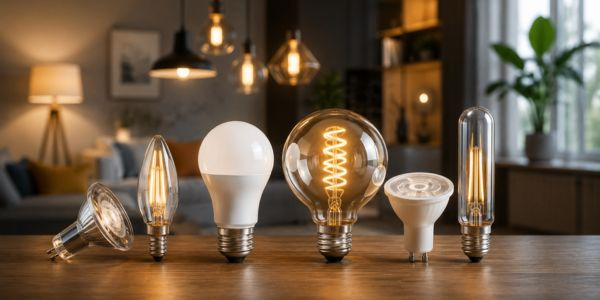
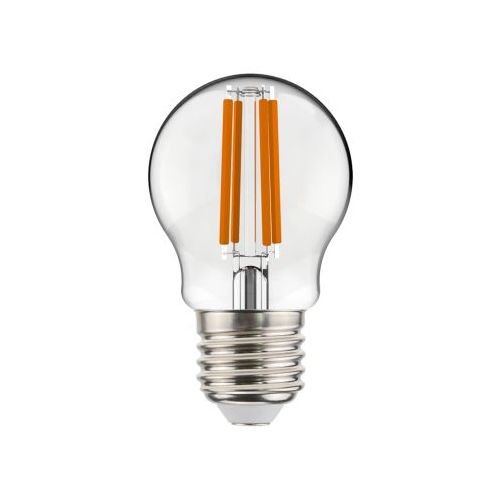
LED bulbs are available in many different shapes, including:
- Globe
- Standard
- Candle
- Reflector
- Tube
- Capsule
- Spiral
- PAR
- AR111
The ideal shape depends on the design of your luminaire, the desired aesthetic and the intended application.

RGB LED Bulbs
RGB LED Bulbs
RGB LED bulbs are equipped with infrared, wireless or Bluetooth receivers, allowing you to change the light colour using a remote control or smartphone app.
RGB stands for:
- R = Red
- G = Green
- B = Blue
By combining these three primary colours, millions of different shades can be created.
Many advanced RGB bulbs also allow you to adjust the colour temperature, brightness and create customised lighting scenes to suit every mood and occasion.

SPOTLIGHT ON OUR ARTICLES
The G25 Collection by Pierre Guariche: Timeless French Design Reissued by Sammode
Discover the G25 collection by Pierre Guariche, featuring the iconic wall light and pendant light faithfully reissued by Sammode. A perfect combination of timeless French design, exceptional craftsmanship and outstanding lighting quality.
Read moreIP44, IP54 or IP65: How to Choose the Right IP Rating for Your Light Fixture
Not sure whether to choose an IP44, IP54 or IP65 light fixture? Discover the differences between these IP ratings, where they should be used indoors and outdoors, and our expert tips for selecting the right lighting for your bathroom, terrace or garden.
Read moreDesigner Cordless Lamps: Portable Lighting for Every Space
Discover why cordless rechargeable lamps have become essential for modern interiors and outdoor living. Explore how to choose the perfect portable designer lamp, understand LED technology, IP ratings and discover premium lighting from Europe’s leading design brands.
Read moreAsteea by Nuura: Scandinavian Lighting Inspired by Nature
Designed by Sofie Refer, the Asteea collection transforms the elegance of flowers into refined Scandinavian lighting. Featuring integrated LED technology, satin brass finishes and textured acrylic shades, the collection includes pendant lights, chandeliers, wall lights, ceiling lights and a portable rechargeable table lamp for both indoor and outdoor use.
Read moreRizzatto by Nuura: Where Mouth-Blown Glass Meets Scandinavian Design
Designed by Paolo Rizzatto for Nuura, the Rizzatto collection combines mouth-blown opal glass, sculptural elegance and soft illumination. Discover refined pendant lights, ceiling lights and chandeliers that blend Italian creativity with timeless Scandinavian design.
Read more