The Complete Guide to LED Light Bulbs: How to Choose the Right Bulb
Choosing a light bulb may seem simple, but today’s market offers a wide variety of bases, light outputs, colour temperatures and technologies. Between watts, lumens, kelvins, LED bulbs, dimmable models and smart lighting, finding the right solution is not always easy.
Yet selecting the right light bulb is essential. The proper lighting improves visual comfort, enhances your interior design, reduces energy consumption and increases the lifespan of your lighting installation.
Today, LED technology has become the benchmark. More economical, longer-lasting and more efficient than traditional halogen or incandescent bulbs, LED lighting provides outstanding illumination while significantly reducing electricity consumption.
In this comprehensive guide, you’ll discover everything you need to know to choose the perfect light bulb for your luminaire, your room and your lighting needs.
Why Choose an LED Light Bulb?
LED light bulbs have gradually replaced traditional incandescent and halogen bulbs thanks to their many advantages.
They consume up to 90% less electricity than conventional bulbs while producing the same — or even greater — brightness.
Their lifespan is equally impressive. While a halogen bulb typically lasts between 2,000 and 4,000 hours, an LED bulb can last 25,000 to 50,000 hours, depending on the model.
Another major advantage is that LEDs generate very little heat. This improves safety and comfort while reducing the risk of overheating, especially in compact light fixtures.
LED bulbs are also available in a wide variety of colour temperatures, shapes, bases and wattages, making them suitable for almost every type of decorative or architectural lighting.
The Main Advantages of LED Bulbs
- Up to 90% energy savings
- Extremely long lifespan
- Instant full brightness
- Very low heat emission
- Wide range of colour temperatures
- Compatible with most designer light fixtures
- Low maintenance
- More environmentally friendly lighting solution

LED, Halogen or Filament: What’s the Difference?
Today, most lighting fixtures use LED technology, although several lighting technologies are still available.
Technology | Energy Consumption | Average Lifespan | Main Advantages |
|---|---|---|---|
LED | Very low | 25,000–50,000 hours | Energy efficient, durable, long-lasting |
Halogen | High | 2,000–4,000 hours | Pleasant warm light but high energy consumption |
LED Filament | Very low | 15,000–30,000 hours | Vintage appearance combined with LED efficiency |
LED
• Power consumption: Very low
• Lifespan: 25,000 to 50,000 hours
• Advantages: Energy-efficient, long-lasting and low power consumption.
Halogen
• Power consumption: High
• Lifespan: 2,000 to 4,000 hours
• Advantages: Pleasant light, but energy-intensive.
LED Filament
• Power consumption: Very low
• Lifespan: 15,000 to 30,000 hours
• Advantages: Vintage appearance with low energy consumption.
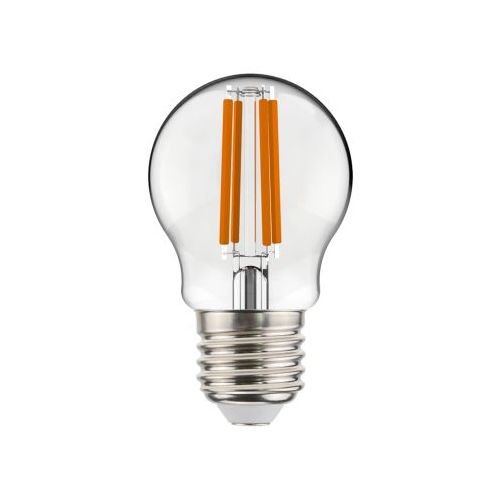
LED filament bulbs have become especially popular among interior design enthusiasts. They recreate the timeless look of classic Edison bulbs while offering all the benefits of modern LED technology.

How to Choose the Right Light Bulb
Looking to reduce your energy consumption? An LED light bulb is the ideal choice.
LED technology is now the most efficient lighting solution available. On average, an LED bulb consumes up to ten times less energy than a halogen bulb while offering a lifespan of several tens of thousands of hours.
When choosing an LED bulb, several important criteria should be considered:
- the type of base;
- the light output;
- the colour temperature;
- dimmer compatibility;
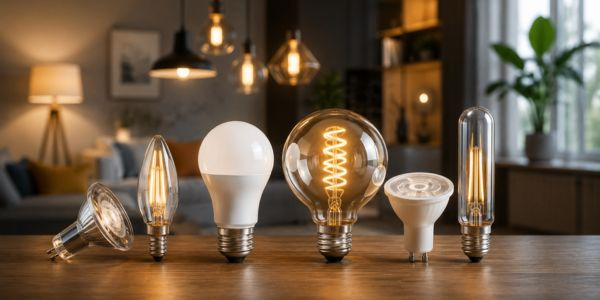
- the bulb shape;
- the lighting technology.
Each of these factors has a direct impact on visual comfort and the overall atmosphere of your interior.

Bulb Types and Bases
LED bulbs are available with many different base types.
The base is the metal fitting that connects the bulb to the light fixture.
Each base is identified by a letter followed by a number indicating its diameter or mounting system.
The most common bases are E27 and E14, although GU10, G9, G4, and even E40 are also widely used for specific applications.
Before purchasing a bulb, always check the base required by your luminaire to ensure perfect compatibility.
The Most Common Bulb Bases
Base | Typical Applications |
|---|---|
E14 | Table lamps, wall lights, chandeliers |
E27 | Pendant lights, floor lamps, ceiling lights |
GU10 | Spotlights and recessed lighting |
G9 | Compact designer luminaires |
G4 | Small decorative lighting fixtures |
E39 / E40 | Industrial and street lighting |
The bulb base is one of the most important selection criteria. Even if the brightness and colour temperature are correct, a bulb cannot be installed if its base does not match your light fixture.

FAQ – How to Choose the Right LED Bulb?
What is the difference between an E27 and an E14 bulb?
An E27 bulb has a 27 mm screw base, while an E14 bulb has a 14 mm base. E27 is commonly used for pendant lights and floor lamps, whereas E14 is typically found in table lamps and wall lights.
How do I choose the right LED bulb wattage?
It is better to compare bulbs by their lumen output rather than their wattage. Lumens indicate the actual amount of light produced.
How many lumens are recommended for a living room?
A living room generally requires between 2,000 and 4,000 lumens, depending on its size and the desired lighting atmosphere.
Which colour temperature should I choose?
Warm white (2700–3000 K) creates a cosy atmosphere, neutral white (4000 K) is ideal for workspaces, while cool white (5000 K and above) provides brighter, more energising light.
What does Kelvin (K) mean?
Kelvin measures the colour temperature of a light source. Lower values produce warmer light, while higher values create cooler, whiter light.
Are watts still important?
Watts only indicate energy consumption. To compare brightness, you should look at the lumen output.
What is a dimmable LED bulb?
A dimmable LED bulb allows you to adjust the light intensity using a compatible dimmer to create the perfect atmosphere.
Which bulb shape should I choose?
The shape depends on your light fixture and the desired style. Common shapes include globe, standard, candle, tube, reflector and capsule bulbs.
Do LED bulbs save energy?
Yes. LED bulbs consume up to 90% less electricity than halogen bulbs while offering a much longer lifespan.
How long does an LED bulb last?
Depending on its quality, an LED bulb can last between 15,000 and 50,000 hours.
What is an RGB LED bulb?
An RGB LED bulb can change colour using a remote control or smartphone app by combining red, green and blue light.
How do I know if a bulb is compatible with my light fixture?
Check the base type, the maximum supported wattage, the bulb dimensions and, if required, its compatibility with a dimmer.
SPOTLIGHT ON OUR ARTICLES
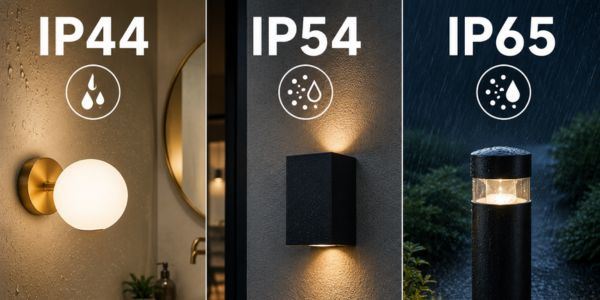
IP44, IP54 or IP65: How to Choose the Right IP Rating for Your Light Fixture
Not sure whether to choose an IP44, IP54 or IP65 light fixture? Discover the differences between these IP ratings, where they should be used indoors and outdoors, and our expert tips for selecting the right lighting for your bathroom, terrace or garden.
Read moreDesigner Cordless Lamps: Portable Lighting for Every Space
Discover why cordless rechargeable lamps have become essential for modern interiors and outdoor living. Explore how to choose the perfect portable designer lamp, understand LED technology, IP ratings and discover premium lighting from Europe’s leading design brands.
Read moreAsteea by Nuura: Scandinavian Lighting Inspired by Nature
Designed by Sofie Refer, the Asteea collection transforms the elegance of flowers into refined Scandinavian lighting. Featuring integrated LED technology, satin brass finishes and textured acrylic shades, the collection includes pendant lights, chandeliers, wall lights, ceiling lights and a portable rechargeable table lamp for both indoor and outdoor use.
Read moreRizzatto by Nuura: Where Mouth-Blown Glass Meets Scandinavian Design
Designed by Paolo Rizzatto for Nuura, the Rizzatto collection combines mouth-blown opal glass, sculptural elegance and soft illumination. Discover refined pendant lights, ceiling lights and chandeliers that blend Italian creativity with timeless Scandinavian design.
Read moreLiila by Nuura: Scandinavian Lighting Inspired by the Beauty of Sunlight
Inspired by the many facets of natural light, the Liila collection by Nuura combines mouth-blown glass with refined Scandinavian design. Wall lights, ceiling lights, sculptural lighting compositions and outdoor models create elegant and timeless interiors designed by Danish lighting designer Sofie Refer.
Read more